 Usdfi
Usdfi Money Legos
USDFI’s Money Legos combine pooled liquidity with DeFi yield strategies through a shared staking interface. Legacy MoneyLegos are no longer supported in their previous form; LP tokens in that legacy system need migration to the upgraded MoneyLegos.
- Participation
- Staking eligible liquidity-provider (LP) tokens into a selected strategy.
- Custom Money Legos
- The introductory documentation describes user-created strategies subject to whitelist approval.
How pooled liquidity becomes a strategy position
Composability combines separate DeFi services into a strategy. Money Legos pool and allocate liquidity across underlying protocols, aiming to reduce the work of managing those services separately. The strategy determines how that capital is used and which dependencies it adds.
For USDFI’s own pools, Stable Pools issue sLP tokens and Variable Pools issue vLP tokens specific to their trading pair. The pool documentation describes both simplified liquidity provision and manual LP-token creation. Using an LP token in a Money Lego is a separate strategy choice, subject to that strategy accepting the token.
A two-token pool exposes its liquidity providers to both assets even when entry uses one token. Placing the LP token into a strategy retains that exposure and adds the strategy’s contract and external-protocol risks.
Performance fees and separate costs
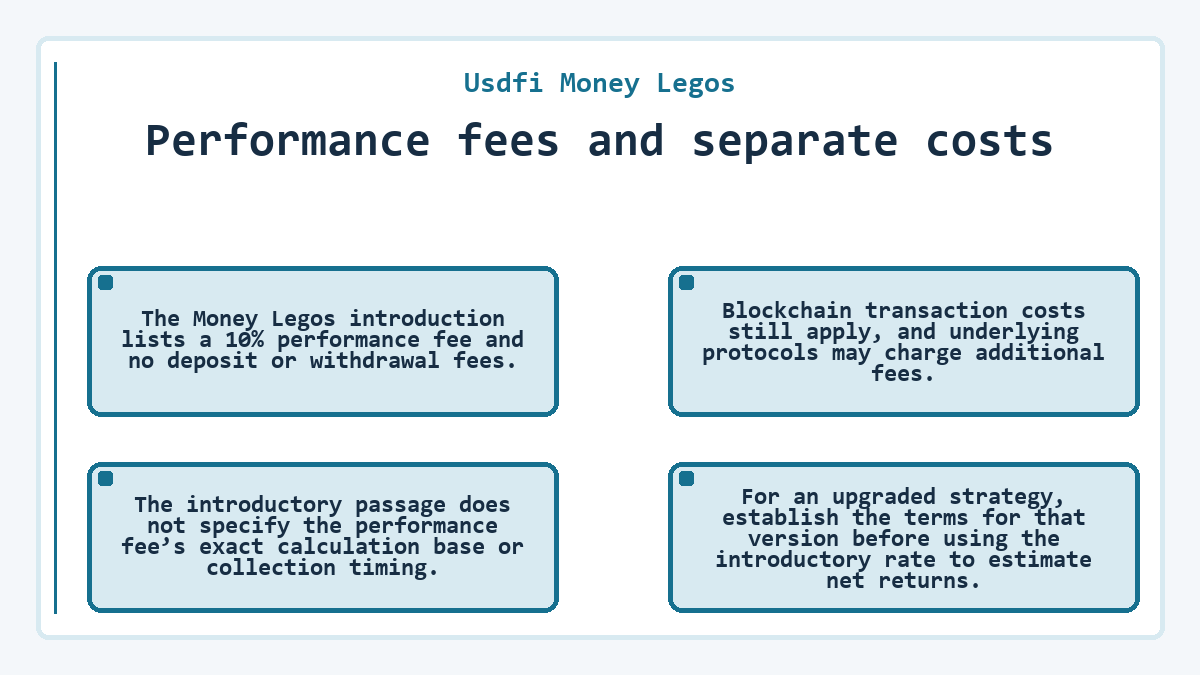
The Money Legos introduction lists a 10% performance fee and no deposit or withdrawal fees. Blockchain transaction costs still apply, and underlying protocols may charge additional fees. The introductory passage does not specify the performance fee’s exact calculation base or collection timing.
For an upgraded strategy, establish the terms for that version before using the introductory rate to estimate net returns.
USDFI rewards and boosted APR
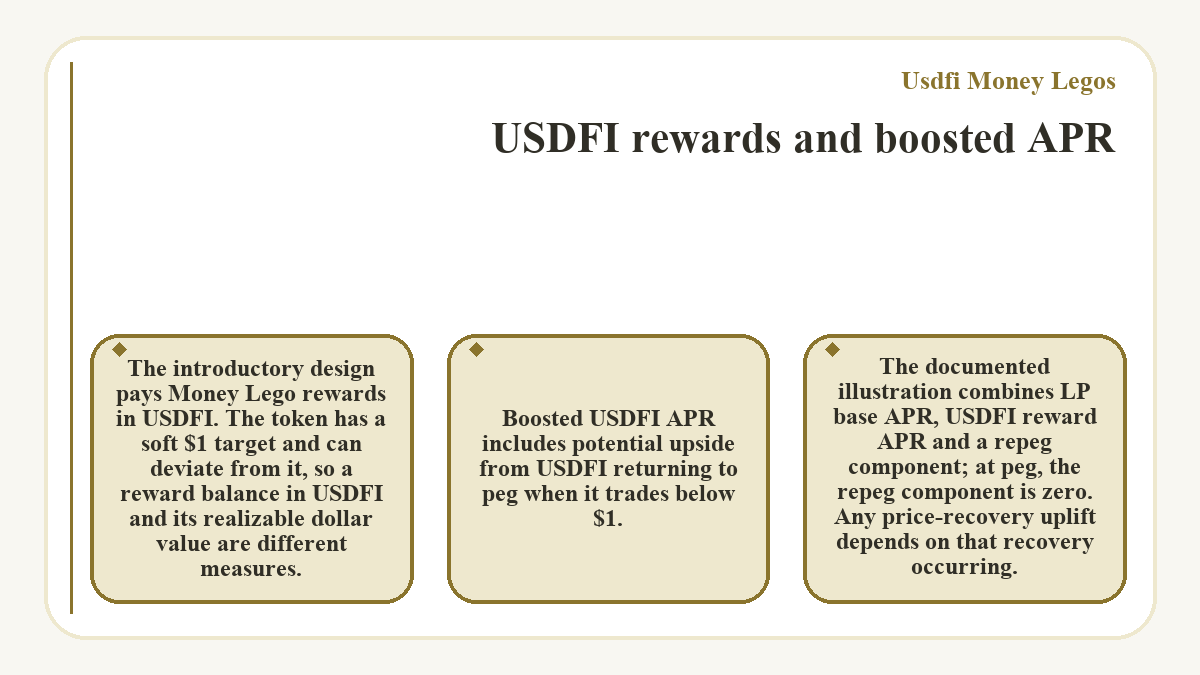
The introductory design pays Money Lego rewards in USDFI. The token has a soft $1 target and can deviate from it, so a reward balance in USDFI and its realizable dollar value are different measures.
Boosted USDFI APR includes potential upside from USDFI returning to peg when it trades below $1. The documented illustration combines LP base APR, USDFI reward APR and a repeg component; at peg, the repeg component is zero. Any price-recovery uplift depends on that recovery occurring.
A reward quote below the value at peg
In this hypothetical example, a Money Lego using the documented USDFI reward design has a reward balance whose dollar quote is lower than its owner expects from the $1 target. Before changing the LP stake, the owner checks the price quoted for the full reward balance.
Hypothetical reward balance: 37.2 USDFI. Hypothetical quote: $0.95 per USDFI, assumed executable for the full balance before fees. Gross reward value:
37.2 * 0.95 = 35.34
, or $35.34.
At a hypothetical quote of $1 per USDFI, the same balance would have a gross value of $37.20. With the $0.95 quote, using $35.34 before fees corrects the valuation without changing the stake. Realizing the additional $1.86 requires recovery to $1 and sufficient liquidity to exchange the balance at that price. If the quote cannot fill the whole balance, this calculation does not establish actual exit proceeds.
Which LP positions need migration
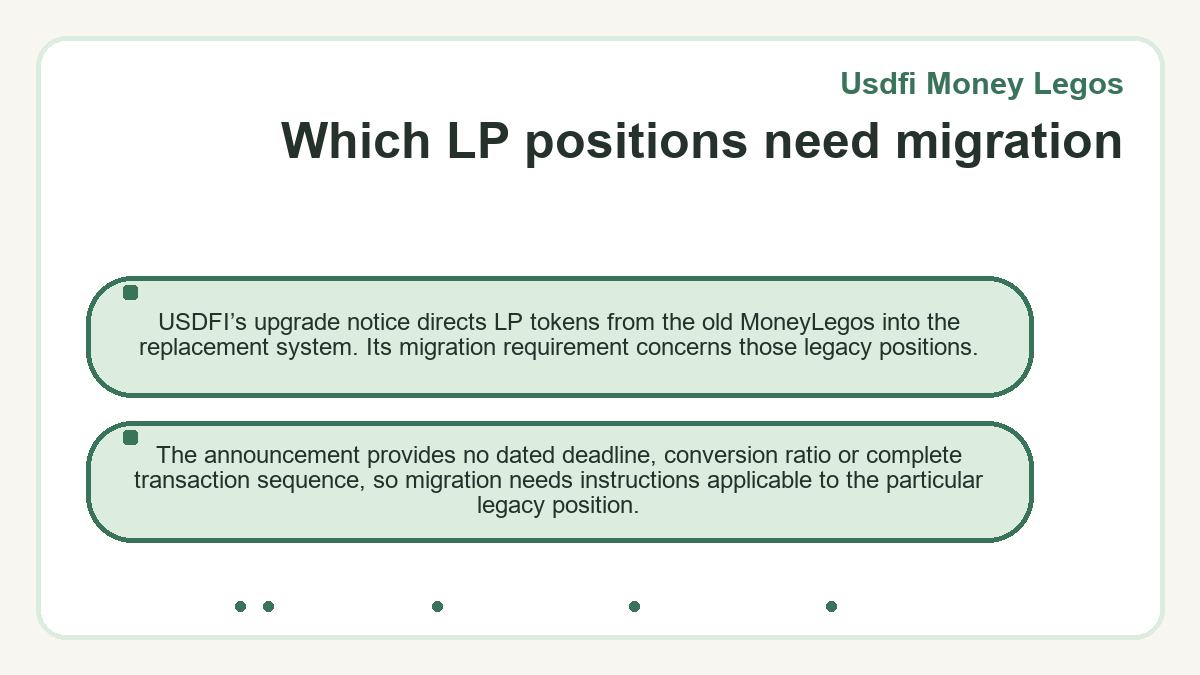
USDFI’s upgrade notice directs LP tokens from the old MoneyLegos into the replacement system. Its migration requirement concerns those legacy positions. The announcement provides no dated deadline, conversion ratio or complete transaction sequence, so migration needs instructions applicable to the particular legacy position.
Strategy contracts and exit limits
Contract faults in a Money Lego or an underlying platform can cause losses. Pool strategies can incur impermanent loss, while strategies involving borrowing can face liquidation. Oracle failures matter where a strategy relies on external price feeds. Limited liquidity can increase slippage or prevent an exit when desired, even when the published withdrawal fee is zero.
Non-custodial operation still involves committing assets to smart contracts. Neither that structure nor an advertised APR guarantees access to the assets at all times or a profitable return.
ChainSecurity’s AMM, gauges and bribes assessment, dated April 24, 2023, covers a defined set of reviewed contracts. Its findings apply to the assessed code and versions; they do not establish coverage of every Money Lego, upgraded strategy or external protocol.