 Usdfi
Usdfi peg stability
The USDFI protocol aims to keep its native USDFI stablecoin near $1 through treasury-funded liquidity operations, buybacks below the target and vote-escrow incentives. Its working paper describes a soft peg that can experience significant short-term price instability.
- Backing model
- Protocol revenues, cash flows and protocol-owned liquidity. The stablecoin design does not rely on USD-linked collateral or overcollateralization.
- Recovery timing
- The working paper describes support intended to restore the peg without specifying a fixed recovery period.
How the response changes around $1
| USDFI/USD state | Treasury or AMM response | Condition or limit |
|---|---|---|
| At the $1 target | Treasury revenues fund yield operations, with proceeds compounded into automated market maker (AMM) liquidity at and around the peg. | This support uses revenue generated by protocol activity. |
| Below $1 | The treasury acts as buyer of last resort and redirects revenues toward USDFI repurchases intended to restore the peg. | Buyback capacity depends on the revenue available for repurchases. |
| Above $1 | The ecosystem FAQ describes the AMM of last resort selling USDFI at a premium. The working paper also states that the protocol AMM allows 1 USDFI to mint $1 worth of STABLE. | The paper presents this as an arbitrage branch, but the stated conversion alone does not establish a profitable trading loop. |
Revenue and STABLE supply support the below-peg response
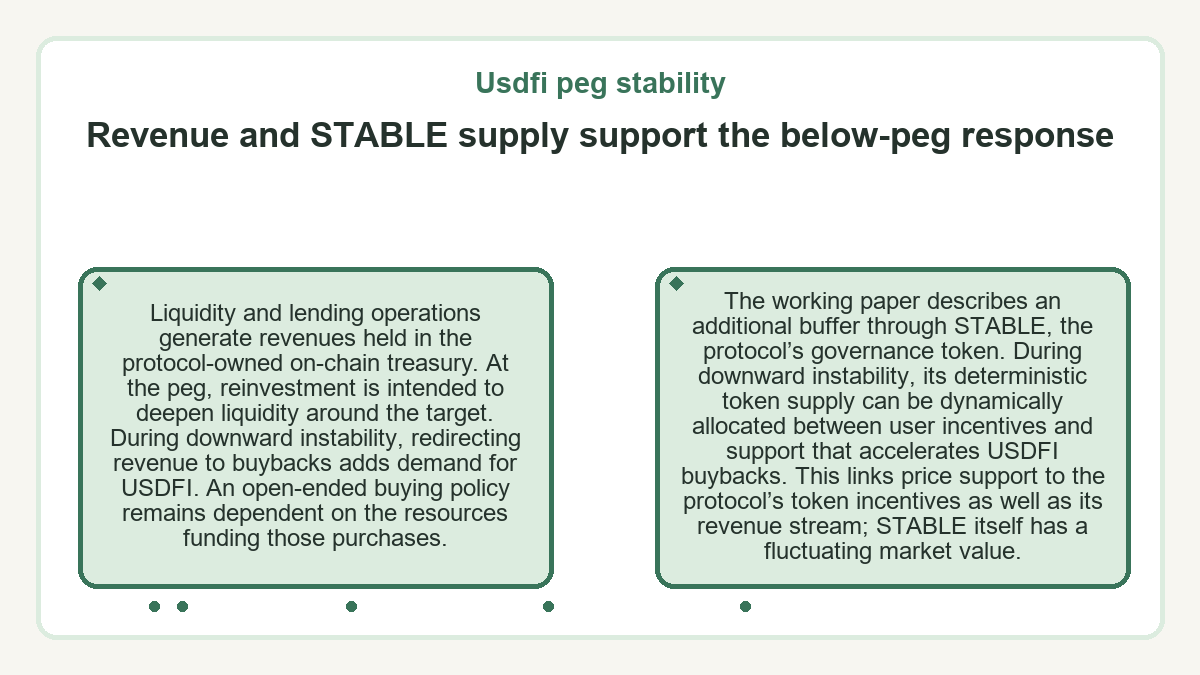
Liquidity and lending operations generate revenues held in the protocol-owned on-chain treasury. At the peg, reinvestment is intended to deepen liquidity around the target. During downward instability, redirecting revenue to buybacks adds demand for USDFI. An open-ended buying policy remains dependent on the resources funding those purchases.
The working paper describes an additional buffer through STABLE, the protocol’s governance token. During downward instability, its deterministic token supply can be dynamically allocated between user incentives and support that accelerates USDFI buybacks. This links price support to the protocol’s token incentives as well as its revenue stream; STABLE itself has a fluctuating market value.
The $1 voting valuation applies inside vote escrow
Locking USDFI produces veUSDFI, which gives holders voting power over pool gauges. The USDFI/veUSDFI overview describes locks of up to four years, with a four-year lock providing the maximum voting and reward boost.
Within the vote-escrow design, the working paper assigns $1 worth of voting weight to 1 USDFI regardless of its market exchange rate. That valuation is intended to encourage demand for discounted USDFI among participants seeking governance influence and associated rewards. Lock duration affects boosts, while fees and bribes depend on the applicable voting and reward allocations.
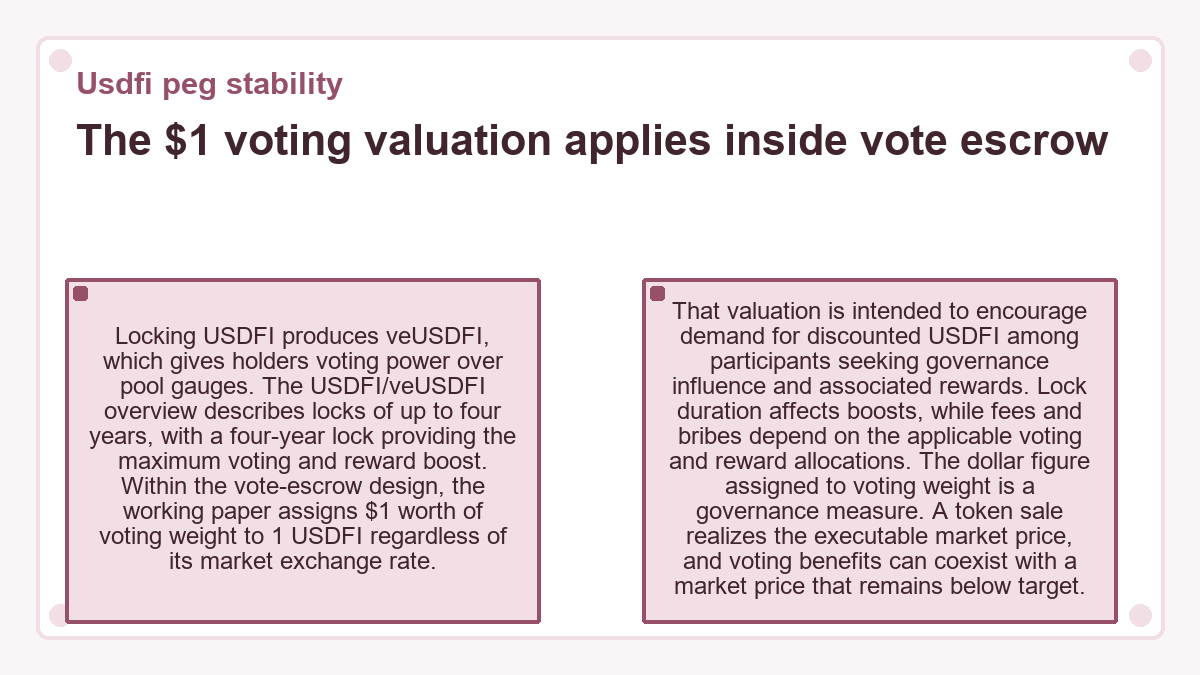
The dollar figure assigned to voting weight is a governance measure. A token sale realizes the executable market price, and voting benefits can coexist with a market price that remains below target.
What the design establishes about recovery
A below-peg market quote shows a departure from the target. It does not establish whether treasury buybacks have executed, how much buying support is available or when the price will recover. The working paper’s expectation of stability over time remains an economic proposition, separate from an observed return to $1.
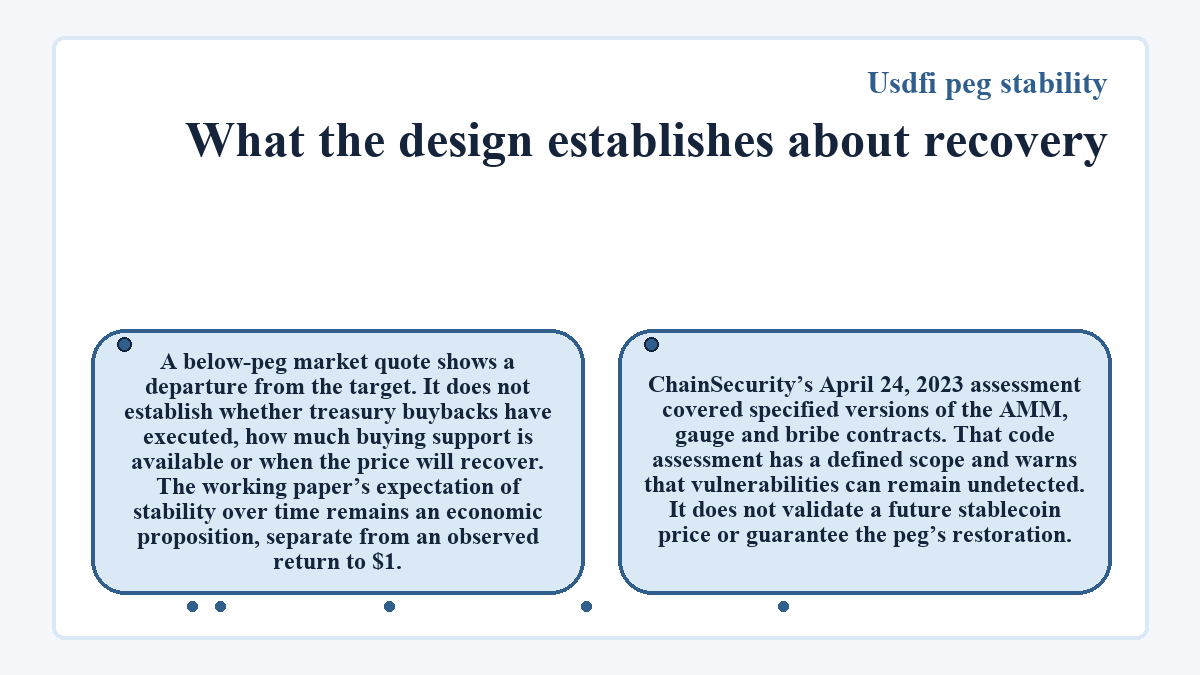
ChainSecurity’s April 24, 2023 assessment covered specified versions of the AMM, gauge and bribe contracts. That code assessment has a defined scope and warns that vulnerabilities can remain undetected. It does not validate a future stablecoin price or guarantee the peg’s restoration.